On Thursday, April 23rd at approximately 8:05 PM Eastern Standard Time, we will begin to learn a lot about NFL front offices and how they think.
Despite being a “down year” for the draft by most analysts’ standards, the 2026 class has brought up tough questions about:
- the nature of positional value,
- the future of positionless football,
- and the tiers of the draft
All that we thought we knew over the past three months of constant draft discussion is sure to be shattered as soon as the fireworks get going in Pittsburgh.
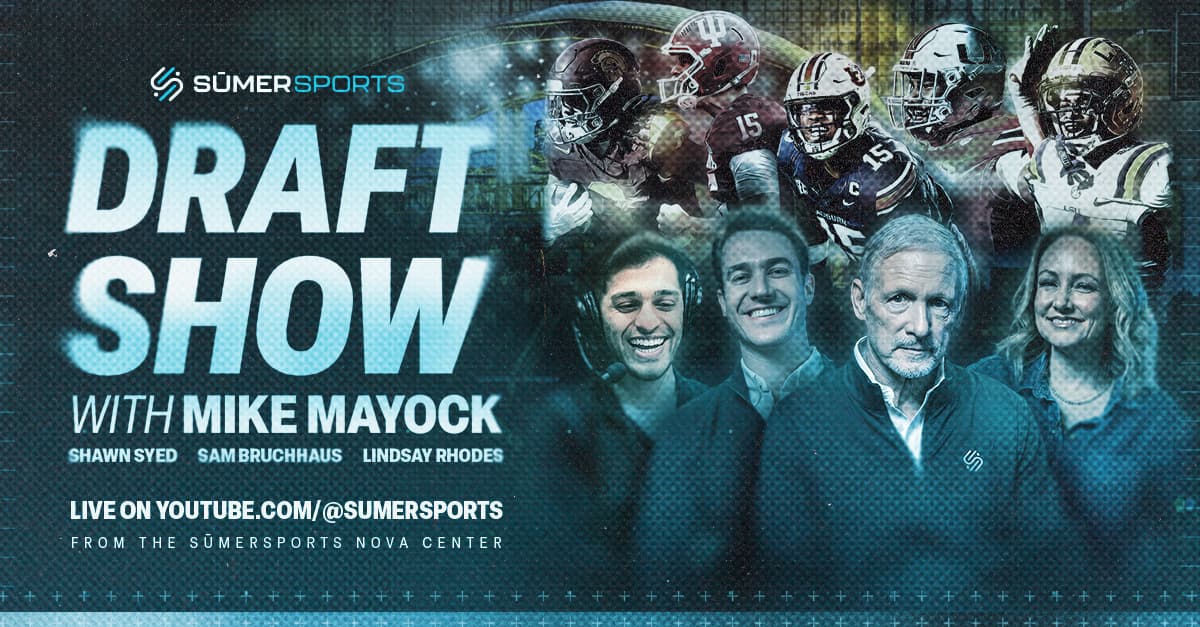
Before reading, make sure to subscribe to SumerSports’ YouTube Channel to prepare for the draft by watching The Evaluation. As the draft unfolds, follow along with Lindsay Rhodes, Mike Mayock, and (yours truly) Sam Bruchhaus.
Pick 1 - Oakland Raiders: Fernando Mendoza, QB (Indiana ← California)
He is -50000 on FanDuel to be the #1 Pick. 99% on Kalshi. Esquire heralded him as a divinely-inspired quarterback to believe in. Fernando Mendoza will be headed to Sin City as the Number 1 pick in the National Football League Draft on Thursday.
Pick 2 - New York Jets: David Bailey, ED (Texas Tech ← Stanford)
On April 1st, Lindsay Rhodes asked me why Arvell Reese was so frequently mocked over David Bailey on the SumerSports Show. At the time, he was around 70% likely to be selected with the Number 2 pick on Kalshi.
My answer at the time: “I have not been able to figure that out at all.”
It turns out there was a reason for that, the market was off.
Unless any news breaks directly from Adam Schefter, Ian Rapoport, or another leading news source, the implied odds across books and markets both sharp and retail will likely continue to bounce between 55% and 45% for either Reese or Bailey.
My analytical case for why the Jets should choose Bailey centers around positional value, stabilization rates, and league translation factors.
The case…
- David Bailey is a true edge defender, while Arvell Reese is a hybrid defender. Edge defenders are by far the most valuable non-quarterback position. Meanwhile, linebackers are amongst the least valuable in the free agency market. To put this in greater relief, the SumerScouts have a blue-chip Impact Starter grade on Arvell Reese at the off-ball linebacker position and a green-chip Quality Starter grade on David Bailey as an edge. Quality Starters at the edge position are currently making an average of $27.6 million. Impact Starters at the linebacker position are making an average of $9.4 million. If Reese cannot rush off the edge, he will be substantially less valuable than Bailey despite a higher scouting grade.
- Arvell Reese did not rush the passer enough to inspire statistical confidence in his ability. Arvell Reese rushed the passer 3 times less than David Bailey this year and hardly rushed at all in years prior. Bailey has 4 years of volume at pass rushing. Stabilization is a concept which posits that at some point in a player’s career a player’s true skills outweigh the randomness inherent in sports. In this situation, stabilization rates imply that David Bailey is amongst one of the best college pass rushers in recent years in terms of pressure rate (22.9%). By sheer lack of snaps, it is difficult to say the same about Reese.
- It is likely that it gets worse for both Reese and Bailey, not better. Every league has a translation factor, meaning the median level of competition is different, which has some general impact on the prediction of statistics. No breaking news here – the NFL is substantially better than the NCAA. This means that, even for Bailey whose dominance stabilized at the college level, it is highly likely both of these players perform worse in the NFL.
To rest my case, even if (1) a team’s scouts and coaches plan to utilize Reese as an edge rusher, the data is (2) quite unconfident that Reese is a better edge rusher than Bailey even at the college level, and (3) it would be anomalous if Reese improved at pass rushing against much steeper competition, at least in his first few years.
All that to say, it would be quite the “called shot” by a team if Reese is substantially better than Bailey at the pro level.
Pick 3 - Arizona Cardinals: Arvell Reese, LB (Ohio State)
The Arizona Cardinals want out of the Number 3 pick. Insiders in league circles have reported that the Cardinals believe that trading back is ideal.
The three flavors of trade partners are:
- A positional value maxing team who has a player with whom they are particularly smitten. The top tier receivers and tackles in this draft will be gone fast. This pressure will likely push a lot of them up into the top 10 picks. There are more top tier tackles than wide receivers though, so a team in this market will probably be looking to grab Carnell Tate, Jordan Tyson, or Makai Lemon. The Saints, Rams, and Giants fit in this market, but it seems low probability they would want to pay the premium to get up to 3.
- A team who believes that the consensus top player is falling, but will be unavailable imminently. Arvell Reese (despite the above) is the consensus top player according to Mock Draft Database and The Athletic. If a team thinks that the Cardinals’ selection is worth the jump up for that premium of a player, they could make the leap. The team I have highlighted here is the Chiefs, where Reese could fit nicely into the Sam-backer position left open by the outgoing Leo Chenal. Also intriguing is the Commanders, whose Dan Quinn and Daronte Jones-led defense prefers hybrid looks which utilize on-ball linebackers in ways that suit Reese’s current skillset.
- A team throwing positional value to the wind who wants to move up to get their “best player available”. This is who the Cardinals were trying to bait when news came out that they were considering Jeremiyah Love. Love and Sonny Styles are likely the best players at their positions in this draft. However, they are at the two least valuable positions – RB and LB, respectively. If a team is moving up in this vein, it feels like it would be particularly for Styles, who the Titans are poised to draft right afterward. In particular, the Cowboys have been in rumors surrounding this pick for weeks.
None of these markets seem exceedingly desperate, however. The straightforward choice is for the Cardinals to choose the consensus top player for their defense that has struggled in recent years.
Pick 4 - Tennessee Titans: Sonny Styles, LB (Ohio State)
The success of the Titans in 2026 hinges on one player: Cameron Ward.
With that in mind, it feels like this premium pick should be centered on offense. The only offensive player across sportsbooks and prediction markets with better than about a 10% chance of being selected at this pick is Jeremiyah Love.
If Jeremiyah Love is taken here, he will immediately become one of the highest paid running backs in the league, and the Titans will get absolutely 0 surplus value from this selection. That is a tall task to ask for a team that was 28th in Expected Points Added Per Play Allowed on defense and 30th in Expected Points Added Per Play on offense.
To be fair, drafting Sonny Styles will not provide very much surplus value either. However, spending premium draft capital on a linebacker seems substantially more likely given that Robert Saleh has had incredible players at that position (Fred Warner, Jamien Sherwood, and C.J. Mosley were the leading tacklers on his defenses between 2018 and 2024).
The Titans are in a massive conundrum here: do they take the player highest on the consensus big board but won’t provide surplus value or take the player who could provide the most surplus value, despite being lower in consensus rankings? Sonny Styles is a sort of “happy medium” through this problem, although his profile certainly leans more to the prior than the latter.
Pick 5 - New York Giants: Caleb Downs, DS (Ohio State)
If Styles is off the board, the retail markets find that Downs is the most likely player to be selected here. Though after the Giants traded for the Number 10 pick in the draft this past weekend, the sharper markets have swung hard to Jordan Tyson.
Why Downs here and not at the Giants’ pick at 10? Evaluator boards have Downs as the 4th best player in this draft. I tend to think NFL teams agree, meaning he would not be on the board much longer if he is not taken with this selection.
Meanwhile, Tyson seems like a reach. Depending on which consensus board you look at, he is between 12th and 15th. A 10 spot jump here feels rich given that there are better consensus rated wide receivers available.
It makes substantially more sense for the Giants to lock down the next best consensus rated player (that is not a running back), especially given their newly hired coach John Harbaugh had the pleasure of working with Kyle Hamilton for the past few years and is taking over a team who has mightily struggled with defensive backfield play.
Pick 6 - Dallas Cowboys ← Cleveland Browns: Jeremiyah Love, RB (Notre Dame)
The Cleveland Browns are in prime position to trade down here.
Their biggest needs are offensive line and wide receiver, two premium positions ripe to be taken in the first 15 picks.
Sure, they could stand pat and select the first of these players from the board.
But, at least as the consensus is concerned, both of these positions are highly clustered. 3 wide receivers sit between the 8 to 15 range on most boards and 3 tackles sit between 6 to 16. The highly analytical Browns likely feel that more shots at the dart board later in the draft is more valuable than grabbing “the guy” at this pick.
Unlike the Cardinals and Titans, the Browns have a trade partner here. Jerry Jones has said that they are “absolutely” open to trading up earlier in the draft season. The Cowboys rarely have traded up in the past, but given the player atop The Athletic’s consensus rankings is available, and likely will not be at 12, this could be a perfect spot for them to strike and add the cherry on top to Klayton Adams’ running game.
What will it take? In 2023, the Cardinals traded for the Lions’ Number 6 pick. That trade netted Detroit about an early 4th round pick in excess value.
The Cowboys multiple picks in the first round and at the turn of Day 2 into Day 3 makes a double first round swap plus one of those later picks quite tempting. Such a trade would net the Browns, who are likely to want more analytical value, an early 3rd Round pick of value and have them remain still squarely in position to net a tackle and a wide receiver in the first round.
Pick 7 - Washington Commanders: Carnell Tate, WR (Ohio State)
As of the night before the first round, the Commanders had the 3rd best odds to draft Love. Given their old rivals have sniped them in this mock, they now turn their eye to their true position of need: wide receiver.
Given new offensive coordinator David Blough played with Amon-Ra St. Brown, it was tempting to slot Makai Lemon, who better fits that mold, in at this selection.
But Jayden Daniels has always excelled at throwing the perimeter deep ball, a skill that defines Tate’s prospect profile.
Not for nothing, Tate was the favorite to go at Number 7 on FanDuel at the time of writing.
Pick 8 - New Orleans Saints: Reuben Bain, ED (Miami)
The Saints have a clear need at pass catcher here.
But, there is a little nugget here that I can’t get out of my head…
Whenever I asked my friends who have been deeply entrenched in Miami’s youth football scene what they thought about Rueben Bain, they replied with two words.
Aaron. Donald.
Now, as a data scientist, I am not one to project the consensus 6th to 9th player in the draft to be one of the greatest defensive lineman of all time.
But, it is of interest that a franchise
- with a defensive coordinator who rose to prominence alongside Donald
- who just let a guy who played a very similar role to that at which Bain might excel (Cameron Jordan) hit free agency
has a chance to select him at market value.
Pick 9 - Kansas City Chiefs: Mansoor Delane, DC (LSU ← Virginia Tech)
The Chiefs let both of their starting corners go (to the Rams, I might add). This is a match made in heaven.
Pick 10 - New York Giants ← Cincinnati Bengals: Jordan Tyson, WR (Arizona State)
On draft week, there are occasions in which smoke equals fire. While I do push back on the fact that a player who people weren’t even discussing as a top 15 pick a week ago could go at Number 5, it is substantially more palatable that the Giants will take him at 10, which the markets tend to suggest.
Pick 11 - Miami Dolphins: Francis Mauigoa, OT (Miami)
Similar to the Saints, the Dolphins have a clear need at pass catcher here. However, the new Miami regime has been shipped in from Green Bay, who notoriously held out on first round pass catchers until Matthew Golden last year, which had mixed results.
Mauigoa at Number 11 would be about a 5 pick fall if you glance at Mock Draft Database. While this could be related to medical news that remains behind closed doors, it seems that the Dolphins would have the greatest access to information regarding the severity of any medical reports given they are in the same city where Mauigoa played ball.
Medicals aside, Austin Jackson has struggled with injury and is on a one-year deal. Mauigoa could start at either guard or tackle on the right side on the first day of being a Dolphin.
Pick 12 - Cleveland Browns ← Dallas Cowboys: Makai Lemon, WR (USC)
Tackle or Wide Receiver? That is the question for the Browns regardless of if they trade back this year.
There are two reasons I think they might jump for Lemon here.
First is the analytics. Target Share and Yards Per Route Run are important statistics in evaluating wide receivers. Lemon’s Yards Per Route Run figure over 3 is only matched by Tate, but Lemon did it at almost 30% Target Share, while Tate’s was only 16%. The combination of production and volume makes Lemon a sparkling analytical candidate, as compared to Tate and Tyson’s more physical trait based projections.
Second is the clustering of this draft. There is a clear dropoff in the wide receiver market between Lemon (between 13 and 14 on consensus boards) and the next best wide receiver (around the early 20s in consensus ranking). This dropoff is not quite as steep at the tackle position.
Especially now that the Browns have the 20th pick rather than the 24th, they are in prime position to grab a tackle later on.
Pick 13 - Los Angeles Rams: Spencer Fano, OT (Utah)
As Brett Kollman astutely pointed out on the most recent SumerSports Show, basically the entirety of the Rams’ team is a free agent after this season. It would be wise to take the best player available here.
That seems to be Fano, who should challenge for one of the starting spots on the offensive line that is tasked to protect the aging Matthew Stafford.
Pick 14 - Baltimore Ravens: Kenyon Sadiq, TE (Oregon)
The Baltimore Ravens are built to play 12 personnel football.
They did it under Todd Monken and are poised to continue doing it under Ben Johnson acolyte Declan Doyle. Both the Ravens and the Bears ranked in the top 6 in 12 personnel usage last year.
Currently, the Ravens only have Mark Andrews and Durham Smythe rostered. Smythe was the third tight end on the depth chart last year behind rookie sensation Colston Loveland.
Doyle would surely like to try his luck again at coaching another rookie sensation tight end in Sadiq.
Now, there is an old analytics adage that if you are drafting a tight end in the first round, you are drafting someone else’s tight end, and the highly analytical Ravens may heed that warning. But at this point of the draft, Sadiq is likely the best skill player available.
Pick 15 - Tampa Bay Buccaneers: Akheem Mesidor, ED (Miami ← West Virginia)
The Bucs have sought to find a second edge rusher alongside Yaya Diaby for years. The markets seem to think Mesidor is the most likely player to come off the board here, so that gap will be filled.
Interestingly, this pick would likely be the biggest reach of the draft thus far as it pertains to the consensus rankings. Mesidor’s ranking is typically in the early 20s, likely due to the fact that he is 25 years of age.
Pick 16 - Philadelphia Eagles ← New York Jets: Monroe Freeling, OT (Georgia)
In what may be the battle of the analytics teams, I have the Eagles trading up to nab the slightly falling Freeling to be the next great, athletic Eagles’ tackle.
The lack of late Day 2 picks for the Jets, but glut for the Eagles is likely what can grease such a trade to each team's liking.
Pick 17 - Detroit Lions: Kadyn Proctor, OT (Alabama)
While Proctor did not test athletically as well as expected, that does not change the fact that Kalen Deboer and Ryan Grubb used him very similarly and uniquely to Dan Campbell’s usage of Penei Sewell.
The Lions’ modus operandi is big, weird athletes and it feels like too much to pass up on given Pick 17 is around Proctor’s consensus rating.
Pick 18 - Minnesota Vikings: Dillon Thieneman, DS (Oregon ← Purdue)
Our SumerScouts are in love with Thieneman. He showed versatility in his transition to Oregon’s defense and that is exactly the type of versatility that projects him to fill in the spot (potentially) left open by Harrison Smith.
Pick 19 - Arizona Cardinals ← Carolina Panthers: Ty Simpson, QB (Alabama)
Last year, the Jaxson Dart trade happened before a run of late first round teams that clearly could’ve picked a quarterback.
The same thing (likely for a very similar price: an early 2nd, a third, and a mid round pick in a future year) feels likely to happen this year.
Simpson has settled as the far and away QB2 in the consensus. If Arizona likes him, it will be tough to hold their water as teams that clearly need a quarterback (Pittsburgh, Cleveland, New York) or analytical teams that would like to trade back (somehow also Cleveland and New York) come up.
As a result, they jump up to take Simpson.
Pick 20 - Cleveland Browns ← Dallas Cowboys: Caleb Lomu, OT (Utah)
As a result of the trade, the Browns now have their pick of the litter of the last three “1B” tackle tier.
Lomu, who played in a diverse run scheme at Utah, feels like an excellent fit for Todd Monken.
Pick 21 - Pittsburgh Steelers: Olaivavega Ioane, OG (Penn State)
With Isaac Seumalo leaving in free agency, the Steelers have a hole at guard. Ioane not only plugs that hole as the consensus best guard in the draft with a blue-chip 1.4% pressure allowed rate, but also seems to be a perfect fit for the Steelers’ organizational culture of hard-working, tough grinders that will likely persist despite the transition from Mike Tomlin to Mike McCarthy.
Pick 22 - Los Angeles Chargers: Kayden McDonald, DT (Ohio State)
When the Chargers lost DT Poona Ford in free agency prior to the 2025 season, I thought for sure that they would use their first round pick on a defensive tackle. Despite the addition of Dalvin Tomlinson, I still think there is a case for a defense that thrives on stopping the run. McDonald sports a blue chip (top 15%) tackle for loss rate amongst college defensive tackles, a statistic that likely stands out to the Chargers’ brass.
Pick 23 - New York Jets ← Philadelphia Eagles: Omar Cooper Jr., WR (Indiana)
The Jets have an interesting conundrum: how do you divvy up 3 picks in about a 20 pick range?
Quality wideouts are unlikely to be available at 33, so the early twenties is the prime range to draft a wide receiver.
Cooper Jr.’s production on screens is a good complement to Garrett Wilson’s versatility.
Pick 24 - Dallas Cowboys: Jermod McCoy, DC (Tennessee ← Oregon State)
At the top of the draft, the Cowboys made a flashy pick: trading up to get Jeremiyah Love.
But at this pick, the Cowboys make a pretty straightforward pick by selecting a player at a position of need who has fallen a bit due to injury reports.
The Cowboys showed a comfortability with doing this at this position by selecting Shavon Revel last year in the third round. Given that McCoy could’ve been a top 10 pick if he would’ve not missed this season, this could be a high ceiling selection from a team that tends to hit on their first-round picks.
Pick 25 - Chicago Bears: Keldric Faulk, ED (Auburn)
Whether it be Cameron Jordan (287 lbs), Marcus Davenport (285 lbs), Montez Sweat (270 lbs), Trey Hendrickson (265 lbs), and Carl Granderson (261 lbs) a stunning amount of Dennis Allen edge rushers have been quite hefty in terms of weight. Faulk (276 lbs) fits this mold and adds another option to a Bears' pass rush unit which was 21st in Sack Rate last year.
Pick 26 - Buffalo Bills: Peter Woods, DT (Clemson)
Preseason, Woods was slated to be a Top 10 pick in most mock drafts. Unfortunately, Woods, like his Clemson team, floundered. He posted sub-average pressure and tackle for loss rates. Despite the potential earnings loss, Woods’ fit as a penetrating defensive lineman on the consistently contending Bills as opposed to a losing team may make him more money in the long run.
Pick 27 - San Francisco 49ers: K.C. Concepcion, WR (Texas A&M ← NC State)
Concepcion had an impressive 2.7 Yards Per Route Run on a 27% Target Share in 2025. He put up these statistics whilst being pressed 31.3% of the time, above the 85th percentile for college wideouts. Adding a young wide receiver alongside the oft-injured Ricky Pearsall, Mike Evans, and Christian Kirk provides support at a position that has seen massive depth issues for the 49ers in past years.
Pick 28 - Houston Texans: T.J. Parker, ED (Clemson)
Similar to Woods, Parker was considered to be a top pick prior to Clemson’s collapse this season. Parker, however, did post a blue-chip pressure rate on early downs. This type of rotational pass rusher provides depth for a Texans team that excels at winning matchups across the front 7 without scheme diversity. Parker replaces the outgoing Derek Barnett and Denico Autry with a developmental pass rusher. This pick also provides a backup option should Danielle Hunter regress with age.
Pick 29 - Kansas City Chiefs: Blake Miller, OT (Clemson)
It is very difficult to get starting tackles outside of the draft. When there was an opening at left tackle last year, the Chiefs addressed it at the back half of the first round by selecting Josh Simmons. They do the same thing now that there is an opening at right tackle.
Pick 30 - Miami Dolphins: Emmanuel McNeil-Warren, DS (Toledo)
Jeff Hafley’s defense thrived in Green Bay due to the play of safeties Xavier McKinney and Evan Williams. According to SumerScout grades, the Dolphins currently have no starting caliber safeties rostered.
An analytical darling, McNeil-Warren certainly showed he could dominate at the G5-level. He seems to have the versatility to thrive in a system like Hafley’s.
Pick 31 - New England Patriots: Keylan Rutledge, OG (Georgia Tech ← Middle Tennessee)
Throughout the draft season, I have bemoaned the fact that Rutledge is rated as a late Day 2-level prospect despite scouts gushing about him and the analytics projecting him as a potential gem.
Then, at the beginning of April, league insider Peter Schrager mocked Rutledge to the Patriots at 31.
I finally felt seen.
This is most definitely my “don’t be surprised if he goes in the first round” prediction, despite it being unlikely with respect to where he currently stands in the consensus.
Pick 32 - Seattle Seahawks: Chris Johnson, DC (San Diego State)
It is an open secret amongst analysts that, despite winning the Super Bowl, the Seahawks offense was not really all that good last year (15th in Expected Points Added Per Play). In fact, they were actually quite awful at running the ball (29th in Expected Points Added Per Rush). However, both offensive tackles are on long term deals, and it feels like they can address interior offensive line depth later in the draft.
Last year, Seattle drafted many “SumerSports Favorites” (Zabel, Arroyo, Horton, White). Chris Johnson is one of those guys this year.
A prospect available at this pick who has strong statistical fundamentals and a Quality Starter level projection from the SumerScouts is Chris Johnson. Johnson fills in the spot left open by Riq Woolen in the Seahawks vaunted corner rotation alongside Josh Jobe and Devon Witherspoon.